
How to get Child Custody and Visitation Rights in Nepal?
Updated: May 5
When a marital union dissolves, the most critical legal concern involves the welfare of the children rather than the division of assets. The legal landscape in Nepal, primarily governed by the Muluki Civil Code, 2074 (2017), is designed to prioritize the "best interests of the child" while maintaining the fundamental rights and obligations of both parents.
In navigating such sensitive and complex matters, Emigrate Lawyers, a leading family law firm in Nepal, provides comprehensive legal assistance in child custody, guardianship, and visitation disputes. The firm represents both onshore and offshore Nepali clients, including Non-Resident Nepalis (NRNs), ensuring that parental rights are protected regardless of geographical location.
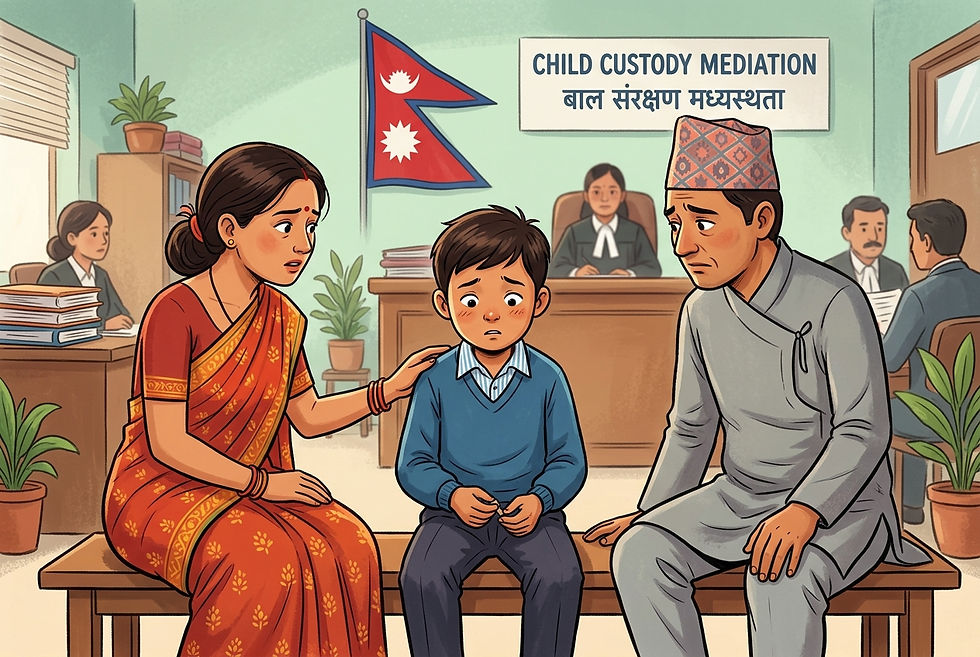
1. Who is considered a minor under the Muluki Civil Code?
Pursuant to Section 2(e) of the Muluki Civil Code, a "minor" is defined as any individual who has not yet attained the age of eighteen years. This chronological threshold is the primary determinant for legal standing in custody matters.
Jurisdictional Significance
The classification of a child as a minor dictates:
Custodial Protection: The eligibility of the individual to be the subject of a custody order.
Parental Authority: The legal right of parents to make decisions regarding the child’s education, health, and residence.
Legal Competence: The transition point at which an individual acquires full capacity to enter into independent legal contracts.
Illustrative Case Examples:
Case A (Parental Consent): If a 17-year-old seeks to relocate for educational purposes, they generally require formal parental consent, as they remain under the legal guardianship of their parents until their 18th birthday.
Case B (Cessation of Litigation): If a child reaches the age of 18 while a custody battle is pending, the court may dismiss the case as "infructuous" (no longer having a legal basis), because the subject has attained the status of a self-governing adult.
2. Does the Parents Divorce affect Child Rights?
A foundational doctrine of Nepali family law is that the rights of the child are distinct and protected, irrespective of the legal status of the parents' relationship. This is codified in Section 75 and Section 118 of the Muluki Civil Code.

Statutory Protections
Non-Prejudice: The dissolution or voiding of a marriage does not diminish the legal rights of the child.
Continuous Obligation: Parental duties, specifically maintenance, education, and healthcare, persist regardless of divorce or separation.
Legal Implications Across Various Marital Scenarios
Illustrative Case Examples:
Scenario 1 (Maintenance Post-Divorce): A father may argue that his obligation to pay tuition fees ended with the divorce decree. Under Sections 114 and 116, this is legally untenable; financial support is an independent obligation to the child, not the ex-spouse. Both father and mother have equal duties towards child.
Scenario 2 (Annulment): Even if a marriage is declared legally non-existent (void), the child born of that union retains full inheritance rights and the right to parental care under the law.
3. What are the different types of child custody in Nepal?
While the Muluki Civil Code, 2074 does not utilize specific modern terminology, the judiciary interprets the statute through three functional custodial models to ensure the child's welfare is maintained post-separation.
(a) Physical Custody (Residential Care)
Physical custody pertains to the child’s primary residence and the daily administration of their upbringing. The custodial parent assumes the immediate responsibility for the child’s fundamental needs.
Primary Obligations: Provision of nutrition, shelter, and safety; management of daily academic logistics; and emotional guardianship.
Legal Basis: Sections 115 (Allocation of Custody) and 116(1) (Duty of Care and Maintenance).
(b) Legal Custody (Decision-Making Authority)
Legal custody involves the authority to make significant, long-term decisions regarding the child’s life. Under Nepali law, this is generally viewed as a shared parental responsibility.
Scope of Authority: Selection of educational institutions, major medical interventions, religious upbringing, and long-term financial management.
Legal Basis: Sections 114 and 118, which stipulate that parental rights and responsibilities remain intact regardless of marital dissolution.
Practical Application: Even if the mother holds physical custody, the father retains the legal right to be consulted on the child’s surgery or change of school. If one parent unilaterally makes a major life decision without consulting the other, the aggrieved parent may seek judicial intervention.
(c) Joint Custody (Consensual Model)
Joint custody is recognized when parents reach a mutual agreement that is subsequently ratified by the court. Section 115(2) explicitly allows for such arrangements to override statutory defaults.
Common Structures:
Alternating Residence: The child spends designated periods (e.g., school terms vs. vacations) with each parent.
Functional Division: One parent manages educational decisions while the other oversees healthcare and extracurricular activities.
4. Who gets custody of a child after divorce (under Section 115)?
The Code provides a default framework based on the age of the minor; however, the court retains the ultimate discretion to deviate from these rules if it serves the child’s best interests.
Age-Based Framework
Illustrative Case Examples:
Scenario A (Remarriage): If a mother remarries, the father may petition for custody. The court will not automatically transfer the child but will evaluate whether the new household environment is conducive to the child’s welfare
Scenario B (Welfare Override): If a father has legal custody but is found to be negligent or abusive, the court can exercise its "parens patriae" (guardian of the state) authority to immediately transfer custody to the mother or a legal guardian.
5. How is child maintenance (child support) calculated in Nepal?
The allocation of physical custody does not absolve the non-custodial parent of financial obligations. Section 116 mandates that both parents contribute to the child's upbringing according to their respective financial capacities.
Scope of Maintenance
Education: Tuition, enrolment fees, stationery, and specialized training.
Healthcare: Medical consultations, insurance premiums, and emergency treatments.
Development: Extracurricular activities, sports, and cultural education.
Financial Contribution Principles
Procedural Steps to Claim Maintenance:
Documentation of Expenses: Compile a comprehensive ledger of the child’s monthly and annual costs.
Financial Disclosure: Present proof of the income and assets of both parents.
Petition for Order: File a formal claim in the District Court.
Interim Relief: Request an "Interim Maintenance Order" to ensure the child’s needs are met during the pendency of the litigation.
Parents are advised to utilize formal banking channels for all maintenance transfers. Informal cash payments lack the evidentiary weight required to prove compliance in court should a dispute arise.
6. Can a parent be denied visitation rights in Nepal?
A fundamental pillar of Nepali family law is the preservation of the parent-child relationship post-separation. Section 117 of the Muluki Civil Code stipulates that the non-custodial parent possesses an inherent legal right to visit and maintain a relationship with the minor.
Core Legal Framework of Visitation
Classification of Visitation Arrangements
Regular Visitation: Scheduled, recurring meetings (e.g., bi-weekly Saturdays).
Extended Visitation: Allocation of significant time during school holidays or festivals (e.g., Dashain or Tihar vacations).
Supervised Visitation: Conducted in the presence of a court-appointed official or a mutually agreed third party, typically utilized in cases involving past safety concerns.
Virtual Visitation: Mandated video conferencing schedules, particularly relevant for parents residing in different cities or abroad.
Illustrative Case Example (Denial of Access):
If a custodial parent unilaterally terminates contact between the child and the other parent, the aggrieved party may petition the District Court for Visitation Enforcement. The court may then issue a fixed schedule and penalize non-compliance.
7. Do both parents share legal guardianship after a divorce?
Pursuant to Sections 124 and 125, parental authority is viewed as a joint venture. Separation does not divest a parent of their legal status as a guardian unless specifically ordered by a court.
Division of Responsibility Post-Separation
Termination of Authority: Parental authority naturally concludes when the child attains the age of 18 (majority), or in specific instances such as the child’s marriage or independent employment.
8. Can a minor live independently without parental consent in Nepal?
Under Section 119, a minor is legally prohibited from residing independently of their parents or guardians without explicit consent. However, the law recognizes practical exceptions.
Exceptions to Residential Restrictions
Gainful Employment: If the minor is engaged in professional work that necessitates relocation.
Partition of Property: Following a legal partition of ancestral property (Ansha).
A 17-year-old relocating for a confirmed employment opportunity is legally distinct from a minor leaving the household without cause. In the latter case, parents may seek judicial assistance to restore the minor to their care.
9. How to enforce child custody and visitation orders in Nepal?
When custodial or visitation rights are infringed, the legal system provides two primary avenues for redress:
(1) District Court Litigation
This is the standard procedure for resolving disputes regarding maintenance, custody, and visitation schedules.
Process: Filing a petition → Preliminary hearings → Seeking Interim Relief (temporary orders for immediate access) → Final Judgment.
(2) Writ of Habeas Corpus
This is an extraordinary legal remedy used only in urgent scenarios where a child is believed to be unlawfully detained or hidden.
Application: Used when one parent conceals the child's location or prevents all forms of communication, effectively "detaining" the minor against their best interests.
10. Visitation Rights for Non-Resident Nepalis (NRN)
Nepali law provides equal standing to parents residing abroad. Given the challenges of distance, the courts increasingly favor “Hybrid Visitation Models”.
Virtual Mandates: Courts often order structured, weekly video calls via platforms like Zoom or WhatsApp.
Consolidated Physical Visits: The non-resident parent may be granted longer, continuous blocks of time (e.g., one month) when they travel to Nepal.
11. How do Nepal courts decide the "best interest of the child"?
The "Best Interest" standard is the lens through which every decision is made. It is a multi-factorial assessment used by judges to override standard age-based rules.
Judicial Evaluation Criteria
Emotional Nexus: The strength of the bond between the child and each parent.
Stability: The continuity of the child’s current educational and social environment.
Moral and Physical Safety: The suitability of the home environment.
Minor’s Preference: Accorded higher value as the child approaches the age of 18.
Final thoughts
The Muluki Civil Code, 2074 establishes a clear legal principle: while a marriage may end, parenthood remains a continuing legal and moral obligation. The law ensures:
Continuity of Care through structured custody and visitation
Financial Security through enforceable maintenance obligations
Judicial Oversight to safeguard the child’s welfare above all
However, in practice, custody and visitation disputes can become legally and emotionally complex, especially in cases involving cross-border families, NRNs, or non-cooperative parents
This is where experienced legal guidance becomes essential.
Emigrate Lawyers stands as a leading family law firm in Nepal, offering expert assistance in:
Child custody disputes
Visitation enforcement
Maintenance claims
Cross-border (NRN) parenting matters
The firm provides services to:
Onshore clients within Nepal
Offshore Nepali citizens
Non-Resident Nepalis (NRNs) dealing with custody or visitation issues from abroad
With a strong understanding of both legal provisions and practical realities, Emigrate Lawyers ensures that parental rights are effectively enforced while keeping the child’s best interest at the center of every case.
Disclaimer: This article is general information only and is not legal advice.
Writer: Bibishika Khanal
Position: Legal Officer at Emigrate Lawyers
Licensed Advocate of Nepal



Comments