
Does Nepali Citizenship Automatically End After Acquiring Foreign Citizenship?
If you’ve ever searched “how to renounce Nepali citizenship in Australia” or “citizenship renunciation letter Nepal sample”, you’re asking the right question, but often at the wrong stage.
For many Nepalis moving toward Australian citizenship, the assumption is simple: once I become Australian, everything else sorts itself out. Legally, that assumption can create serious complications.
Renouncing Nepali citizenship is not just a procedural step. It is a decisive legal event that affects your identity, your rights in Nepal, and your future options. In practice, it is a point you cross once, with limited pathways back.
If you are unsure at any stage, Emigrate Lawyers routinely assist Nepalis in Australia and all over the world with structuring this transition correctly so that there are no gaps in legal status or documentation.

When exactly does Nepali citizenship end? A clear explanation of Section 10
The starting point is the legal ground provided in Section 10 of the Citizenship Act, 2006 (Nepal). It appears straightforward, but its implications are often misunderstood.
Instead of scattered interpretations, the legal position can be understood more clearly in the following structured way:
In legal terms, this is not symbolic or discretionary. It is an absolute termination of citizenship status. This is precisely why immigration and citizenship lawyers often refer to this step as the “point of no return.”
However, the law creates a distinction that is critical to understand: automatic loss under law does not replace the need for formal administrative closure.
A Common Question: “I already lost my Nepali citizenship, so why do I need to formally renounce it?”
Consider Aaravi Gurung, after nearly a decade in Melbourne, Aaravi finally secures Australian citizenship. Like most applicants, her first question is not legal, it is practical:
“Do I lose my Nepali citizenship automatically?”
The answer is yes. Under Section 10(1), the moment he acquires Australian citizenship, her Nepali citizenship is legally extinguished.
But this is where confusion begins.
Aaravi assumes that because the law says she has “lost” citizenship, there is nothing more to do. Months later, when dealing with property matters in Nepal and documentation for NRN status, she discovers that her legal position is incomplete.
This is because the law operates on two levels:
Without completing the second step, individuals often face complications in:
Property transactions in Nepal
NRN card applications
Visa or residency documentation
Banking and inheritance matters
This is where structured legal guidance becomes essential. Emigrate Lawyers, for example, regularly assists clients in aligning both the legal reality (loss under Section 10) and the administrative requirement (formal renunciation and certification) to avoid future disputes or delays.
It may seem redundant to renounce something you have already lost. Legally, however, the distinction is significant.
The process of formal renunciation:
Creates an official government record of termination
Generates a citizenship renunciation certificate
Enables NRN status applications
Provides proof for foreign authorities, including in Australia
This is particularly important in cross-border legal systems, where documentation, not assumptions, determines your rights. Automatic loss changes your legal status. Formal renunciation proves it.
Many Nepalis assume the process is either automatic or purely procedural. In reality, it is both, and misunderstanding that dual nature is where most problems arise.
The safest approach is to treat renunciation as a two-step legal transition:
Recognition that citizenship has ended under Section 10 of Nepal Citizenship Act
Completion of the formal renunciation process to document that change
Handled correctly, this transition is smooth and predictable. Handled incorrectly, it can create long-term complications across immigration, property, and financial matters.
How do you renounce Nepali citizenship from Australia or Nepal? A step-by-step comparison most people miss
Once you understand that citizenship can end automatically under Section 10, the next practical question becomes far more important: what do you actually need to do to formalise it?
The answer depends on where you are physically located. While the legal outcome is the same, the procedure, documentation flow, and timeline differ significantly between applying from Australia and applying within Nepal.
Can you renounce Nepali citizenship from Australia without returning to Nepal?
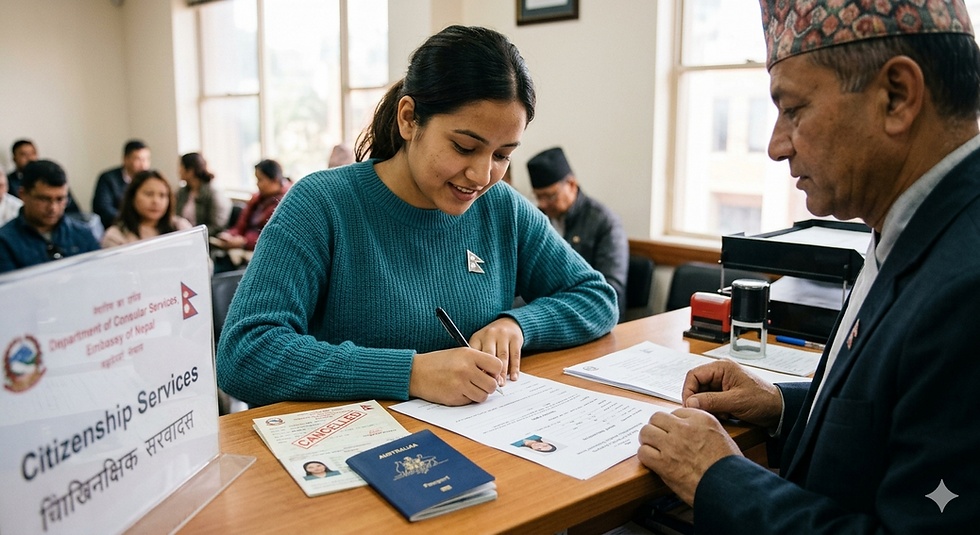
Yes. One of the most common misconceptions is that you must travel back to Nepal. In reality, Nepali law allows you to complete the process through diplomatic missions abroad.
Renunciation through Embassy or Consulate (Australia-based applicants)
Processing timeline
At first glance, the process appears quick. However, the timeline reflects an important legal reality: the embassy does not finalize your renunciation, it initiates it.
This is why many applicants underestimate the process. Emigrate Lawyers often assists clients in tracking and following up on applications to ensure the final registration in Nepal is not delayed, which is crucial for NRN and legal documentation purposes.
What actually happens behind the scenes? (Rule 9 explained in practice)
The legal mechanism governing overseas renunciation is found in Rule 9 of the Citizenship Regulations, 2063 BS. While the wording is technical, the process can be understood more clearly in structured form:
The most important takeaway is often overlooked:
Your citizenship is not legally terminated at the embassy; it is terminated when the Chief District Officer registers it in Nepal.
This distinction is critical. Many individuals assume they are “done” after visiting the embassy, only to face issues later when no official record exists in Nepal. Proper follow-through is essential, and this is another area where Emigrate Lawyers provides ongoing support to ensure completion, not just submission.
Can you apply in Nepal to renounce Nepali citizenship instead?
For those physically present in Nepal, the process is more direct but requires personal presence and strict documentation.
Renunciation through District Administration Office (DAO)
Although the process appears simpler, it is still legally sensitive. Missing documentation or incorrect filings can delay registration. Many applicants engage legal professionals such as Emigrate Lawyers to ensure compliance, especially when foreign citizenship documentation is involved.
What is “Schedule 9” and why is it so important?
If there is one document that defines the entire process, it is Schedule 9 under the Citizenship Regulations. Rather than being a simple form, Schedule 9 is a formal legal declaration. It is the document through which you notify the Government of Nepal: “I voluntarily renounce my citizenship.”
Its legal significance can be better understood as follows:
This means that Schedule 9 is not just paperwork, it is the trigger document that activates the legal termination process.
When exactly does your citizenship legally end?
This is one of the most misunderstood aspects of the law. Your Nepali Citizenship ends only when the state records the renunciation.
This Registration by the Chief District Officer is critical because it determines your:
Legal identity
Property rights
Inheritance eligibility
Immigration and visa status
Any mismatch between your assumed status and recorded status can create legal complications. This is why careful coordination, often handled by firms like Emigrate Lawyers, is essential.
Once your citizenship is terminated, you are no longer a Nepali citizen. You become a foreigner immediately. This creates an immediate shift in your legal standing.
This is where NRN (Non-Resident Nepali) status becomes not just useful, but necessary.

Why is NRN status almost essential after renunciation?
NRN status functions as a legal bridge. It does not restore citizenship, but it restores certain practical rights that would otherwise be lost.
For most former Nepali citizens, NRN status becomes the only structured way to maintain long-term ties with Nepal. This transition, from citizen to NRN, is one of the most critical phases, and it is often where applicants seek guidance from Emigrate Lawyers to ensure continuity in both legal rights and personal connections.
Can you ever get Nepali citizenship back after renouncing it?
Legally, yes, but the pathway is deliberately restrictive.
Under Section 11 (Re-acquisition of Citizenship) of the Nepali Citizenship Act, the process requires a complete reversal of your previous decision.
Renunciation is not easily reversible. You can return, but only by surrendering what you gained.
Frequently asked questions
Q1. How do I renounce Nepali citizenship from Australia?
A- You can apply through the Nepali Embassy or Consulate by submitting your citizenship documents, passport, photographs, and proof of foreign citizenship. While passport cancellation may happen quickly, the full citizenship renunciation process typically takes 3 to 6 months due to registration requirements in Nepal.
Q2. When is renunciation legally complete?
Renunciation is legally complete only when it is registered by the Chief District Officer in Nepal. Submission at the embassy or DAO alone does not finalize the process.
Q3. Why is NRN status important after renunciation?
After renunciation, you become a foreign national. NRN status allows you to maintain certain connections with Nepal, including property rights, investment opportunities, and long-term stay options within the legal framework.
Q4. Can I get my Nepali citizenship back later?
Yes, but only if you renounce your foreign citizenship, return to Nepal, and apply under Section 11. In practical terms, this makes renunciation a highly consequential and often irreversible decision.
Final thoughts: Is renouncing Nepali citizenship just a formality?
It is easy to treat renunciation as the final checkbox in a long immigration journey. In reality, it is one of the most legally significant steps you will ever take. Renouncing Nepali citizenship is not simply about obtaining another passport. It is about closing one legal chapter while opening another, under a completely different framework.
Because the consequences are long-term and often irreversible, the process should never be approached casually. From understanding Section 10 to ensuring proper registration and transitioning into NRN status, each step must align.
This is where professional guidance becomes critical. Emigrate Lawyers regularly supports Nepalis in Australia and globally through this transition, ensuring that every stage, from initial advice to final documentation, is handled with precision and care.
If you have any questions, concerns, or requests related to the legal matter, please contact us at:
Emigrate Lawyers
Email: info@emigratelawyers.com
WhatsApp: 0458 745 646
Phone: 1300 807 134
Text Us: 0483 959 572
Disclaimer: This content is provided for general informational and educational purposes only and does not constitute legal advice. It is not intended to be a substitute for professional legal consultation or to be relied upon for making specific decisions. Laws, regulations, and policies may change over time, and their application can vary depending on individual circumstances.
Writer: Bibishika Khanal
Position: Legal Officer at Emigrate Lawyers
Licensed Advocate of Nepal



Comments